- What happens in the brain after waking?
- Why morning news can feel mentally overwhelming
- How negative news may affect the stress response
- Effects on attention and cognitive performance
- Doomscrolling, uncertainty, and emotional well-being
- Does morning phone use affect dopamine?
- Is checking the news in the morning always harmful?
- How to create a healthier morning news routine
- Final verdict
Checking the news first thing in the morning has become an automatic part of many people’s daily routines. Before getting out of bed, a person may check messages, social media notifications, financial updates, breaking news, political developments, or distressing international events.
This behavior is often described as harmless information gathering. However, the first minutes after waking represent a transitional period in which alertness, attention, emotional regulation, and executive function may not yet be operating at their normal daytime level.
Research has not yet directly established that checking smartphone news immediately after waking causes lasting changes in brain function. Most available evidence comes from related areas, including sleep inertia, negative-news exposure, smartphone notifications, media multitasking, and doomscrolling.
Taken together, this evidence suggests that beginning the day with a rapid stream of emotionally charged information may temporarily increase cognitive load, direct attention toward threats, worsen mood, and make sustained concentration more difficult—particularly when news consumption becomes repetitive or uncontrolled.
What Happens in the Brain After Waking?
Waking is not an instantaneous transition from sleep to full cognitive performance. The brain passes through a temporary state known as sleep inertia.
Sleep inertia is characterized by:
- Reduced alertness
- Slower reaction time
- Impaired working memory
- Lower cognitive throughput
- Increased subjective sleepiness
- Temporary difficulty with complex decision-making
Brain systems involved in basic arousal appear to recover relatively quickly after waking, while anterior cortical regions associated with executive control and higher-order cognition may take longer to reach normal daytime activity. Experimental research has found measurable differences in alertness, attention, working memory, and cognitive performance during the period immediately following awakening.
The severity and duration of sleep inertia vary depending on sleep duration, sleep stage at awakening, circadian timing, sleep quality, and individual chronotype. For some people, the effects may resolve within minutes. For others—particularly those who are sleep-deprived—the transition may last considerably longer.
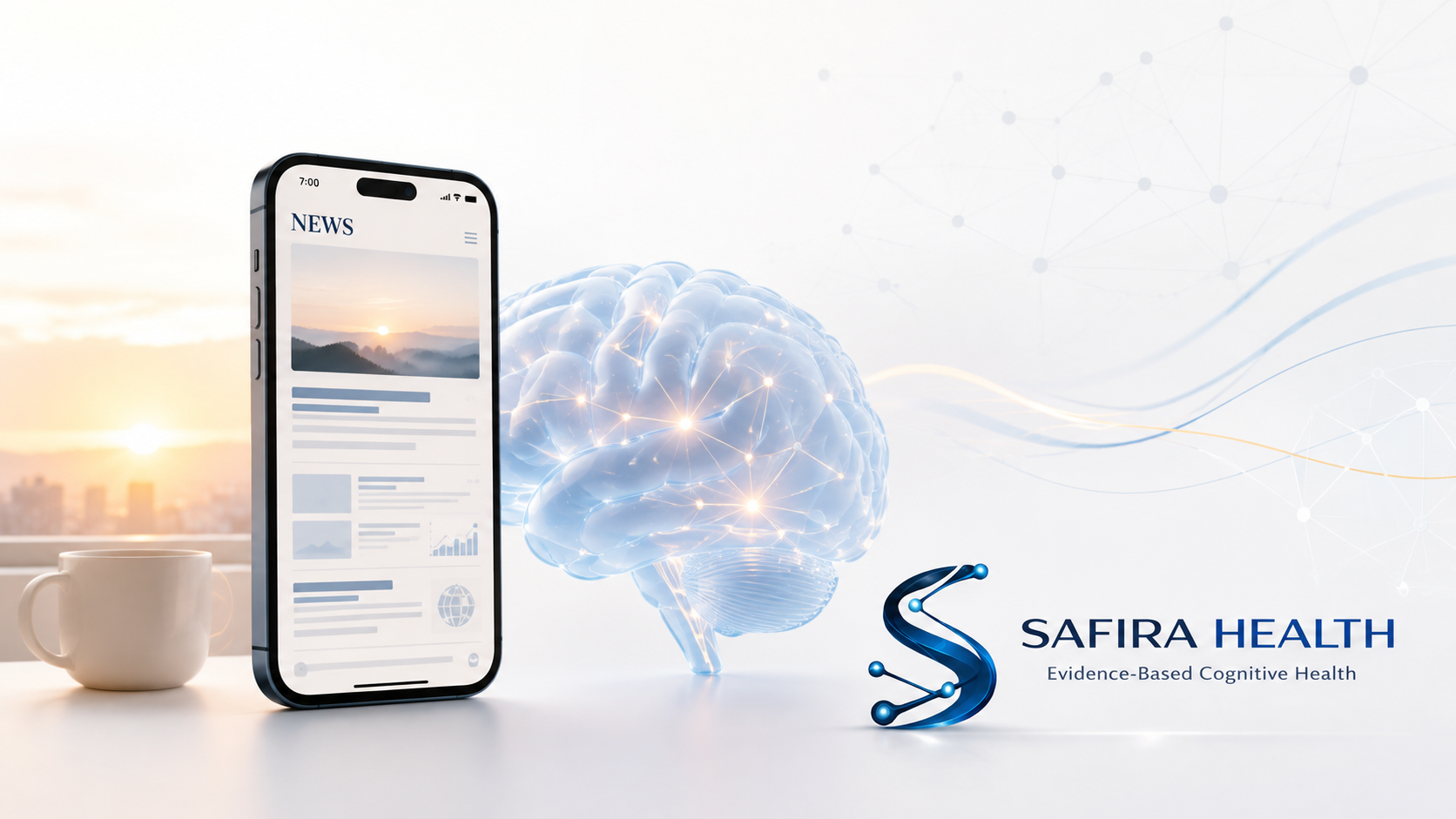
Checking the news first thing in the morning may influence attention, mood, stress reactivity, and the ability to begin the day with sustained focus
Why this matters for morning news consumption
News applications require the brain to perform several demanding operations:
- Shift attention rapidly between unrelated topics
- Interpret emotionally significant information
- Decide which stories are credible or relevant
- Process uncertainty and potential threats
- Resist notifications, advertisements, and suggested content
- Decide whether to continue scrolling
Performing these tasks while executive control is still recovering may make the experience feel more overwhelming than reading the same information later in the day.
This does not mean that the waking brain is unusually fragile or that viewing a phone causes neurological damage. Rather, the timing may place a high-information activity into a period when cognitive efficiency has not fully stabilized.
Why Morning News Can Feel Mentally Overwhelming
Modern news platforms are not neutral streams of information. They are designed to attract attention through breaking-news alerts, emotionally charged headlines, personalized recommendations, rapidly changing feeds, and continuous opportunities to scroll.
Each headline creates a small decision:
- Should I open this story?
- Is this information relevant to me?
- Has the situation become worse?
- Do I need to act?
- Should I check another source?
This repeated decision-making adds to cognitive load, referring to the amount of information being processed within the brain’s limited working-memory capacity.
When news is mixed with emails, messages, social media posts, market updates, and work notifications, the brain must repeatedly switch between contexts. The result may be a fragmented attentional state before the person has identified the priorities of the day.
Smartphone notifications can disrupt attention even when the phone is not actively opened. In an experimental study, receiving a notification impaired performance on an attention-demanding task despite participants not interacting with their devices.
Evidence regarding the mere physical presence of a smartphone is less consistent. Some studies report lower attentional performance when a phone is nearby, while replication studies have not always observed the same effect. The more reliable concern appears to be the phone’s availability, personal relevance, notifications, and the expectation that new information may arrive.
How Negative News May Affect Stress Response
The human attentional system is naturally sensitive to potential threats. From an evolutionary perspective, rapidly detecting danger has greater immediate survival value than noticing neutral information.
This tendency is sometimes called negativity bias. Negative headlines involving conflict, disease, violence, economic instability, or disaster may therefore attract and retain attention more effectively than neutral or positive stories.
Negative news and cortisol
Cortisol is a glucocorticoid hormone involved in energy regulation, alertness, immune function, and physiological response to stress. Cortisol normally increases after waking as part of the cortisol awakening response.
It is sometimes claimed that checking the news immediately raises cortisol or “puts the brain into fight-or-flight mode.” The scientific evidence is more nuanced.
In one controlled study, reading negative news did not directly produce a significant immediate increase in cortisol. However, women exposed to negative news showed a greater cortisol response to a subsequent laboratory stressor and remembered more of the negative stories afterward. The same statistically significant effect was not demonstrated in men.
These findings suggest that negative news may, under certain conditions, influence how strongly a person responds to stress occurring later. They do not prove that every negative headline triggers a clinically meaningful stress response or that the effect occurs equally across sexes and individuals.
Emotional relevance matters
News appears to have a stronger emotional effect when it is perceived as personally relevant.
Daily-life research has found that perceiving news as negative is associated with greater negative affect and lower positive affect. The emotional effect was stronger when participants considered the news personally significant. Experimental evidence has also found increases in sadness, worry, anxiety, and negative affect following exposure to negative news reports.
A story about a distant event may have little emotional impact on one reader but may be highly stressful to someone with family, financial interests, health concerns, or personal experiences connected to that event.
Morning news consumption may therefore be particularly disruptive during periods of war, political instability, natural disaster, economic uncertainty, or personal health anxiety.
Effects on Attention and Cognitive Performance
Checking a single headline is unlikely to cause a meaningful decline in cognitive function. The more relevant issue is the pattern of use that follows.
A brief news check can quickly develop into:
- Opening a notification
- Reading several related stories
- Checking social media reactions
- Moving to email or messaging applications
- Returning to the news feed
- Continuing to scroll through algorithmically suggested content
This sequence repeatedly shifts the brain’s attentional target.
Attention becomes externally directed
When the first activity of the morning is checking notifications, the phone determines which information receives priority. Attention becomes organized around external demands rather than internally selected goals.
This may increase the likelihood of beginning the day in a reactive state:
- Responding instead of planning
- Monitoring instead of concentrating
- Consuming instead of creating
- Switching tasks instead of completing them
The problem is not that the brain permanently loses its ability to focus. Rather, rapid information switching can establish an attentional pattern that is poorly matched to later activities requiring sustained reading, writing, studying, or problem-solving.
Notifications can leave attentional residue
After reading an alarming headline, part of a person’s attention may remain focused on the story even after the phone has been put away.
Questions such as “What will happen next?” or “Should I check for another update?” may continue occupying working memory. This unresolved cognitive activity can compete with the task that follows.
The effect is likely to be stronger when:
- The story is personally relevant
- The outcome is uncertain
- Updates are expected throughout the day
- The person feels unable to influence the situation
- Notifications remain active
- The individual already experiences anxiety or poor sleep
Experimental electrophysiological findings also indicate that smartphone notifications can alter neural activity during attention tasks, although the meaning and real-world magnitude of these changes require further research.
Doomscrolling, Uncertainty, and Emotional Well-Being
Doom scrolling refers to repeatedly searching for or consuming negative online information, even when the experience causes distress or no longer provides useful knowledge.
It is different from intentionally reading a morning news summary. Doomscrolling typically involves:
- Difficulty stopping
- Repeated checking for updates
- A focus on threatening or catastrophic content
- Movement between news and social-media reactions
- Feeling worse without feeling better informed
- Continued scrolling despite other responsibilities
Research has associated doomscrolling with psychological distress, lower mental well-being, fear of missing out, problematic social-media use, and reduced mindfulness. However, much of this evidence is correlational, meaning it cannot determine whether doomscrolling causes distress, whether distressed individuals are more likely to doomscroll, or whether both processes reinforce each other.
A study of 400 adults found that the relationship between doom scrolling and poorer well-being was statistically linked to lower mindfulness and greater secondary traumatic stress. Secondary traumatic stress describes distress that may develop through repeated exposure to other people’s traumatic experiences rather than direct exposure to the event itself.
The uncertainty loop
People often continue checking news because they believe the next update will reduce uncertainty.
Occasionally, this is useful. A new report may provide actionable information. More often, however, continuously developing stories offer repeated fragments without resolution.
The result can become a self-reinforcing loop:
Uncertainty → checking → temporary reassurance → new alarming information → renewed uncertainty → more checking
This pattern may be especially powerful in the morning because the person has not yet become engaged in another meaningful task.
Does Morning Phone Use Affect Dopamine?
Online discussions frequently claim that checking a smartphone in the morning causes a “dopamine spike,” depletes dopamine, or damages the brain’s reward system for the rest of the day.
These explanations are usually oversimplified.
Dopamine is not simply a pleasure chemical, and it is not used up in the way that a battery loses its charge. Dopaminergic pathways contribute to motivation, learning, salience, reward prediction, movement, and the decision to pursue potentially valuable information.
News feeds may reinforce checking behavior because updates are unpredictable. Sometimes there is nothing important; sometimes there is highly relevant information. This variable pattern can make checking habitual.
However, current evidence does not demonstrate that reading smartphone news after waking produces a unique dopamine surge that permanently reduces motivation or attention later in the day.
A more scientifically defensible explanation is that repeated morning checking may strengthen a learned behavioral routine:
Waking → noticing the phone → checking for new information → receiving novelty or relief
Over time, the cue of waking or seeing the phone may be sufficient to trigger the urge to check it automatically.
Is Checking the News in the Morning Always Harmful?
No. News consumption is not inherently harmful, and staying informed can support responsible decision-making, professional preparation, civic engagement, and personal safety.
The effect depends on several variables:
| Factor | Lower-risk pattern | Higher-risk pattern |
| Duration | Brief, predefined check | Open-ended scrolling |
| Content | Balanced daily summary | Repeated crisis coverage |
| Purpose | Specific information goal | Habitual reassurance-seeking |
| Source | One or two reliable outlets | Multiple conflicting feeds |
| Notifications | Muted or scheduled | Continuous breaking-news alerts |
| Emotional state | Calm and well-rested | Anxious, sleep-deprived, or overwhelmed |
| Timing | After basic morning orientation | Immediately upon opening the eyes |
| Control | Intentional stopping point | Difficulty disengaging |
A five-minute review of a trusted news summary is cognitively different from spending 45 minutes moving between crisis headlines, social-media arguments, videos, and notifications.
Positive and neutral news also do not appear to produce the same emotional effects as negative news. In a controlled experiment, exposure to positive or neutral news did not significantly alter stress reactivity, memory, or affect.
The objective should therefore not necessarily be complete news avoidance. A more realistic goal is intentional news consumption.
How to Create a Healthier Morning News Routine
1. Create a short phone-free transition
Allowing a brief interval between waking and consuming news gives sleep inertia time to diminish and provides an opportunity to establish the day’s priorities.
There is no scientifically established universal rule requiring exactly 30 or 60 phone-free minutes. A practical starting point may be 15–30 minutes, adjusted according to work requirements and individual circumstances.
During this interval, consider:
- Opening the curtains or going outside
- Drinking water
- Washing and getting dressed
- Performing several minutes of light movement
- Preparing breakfast
- Writing the day’s three main priorities
Morning light may support alertness and circadian regulation. Therefore, the central concern with morning smartphone news is not primarily blue-light exposure, as it is with late-night screen use. The more relevant factors are emotional content, cognitive load, notifications, and uncontrolled scrolling. Research on waking performance suggests that appropriately timed light exposure may modestly improve alertness and some aspects of cognitive performance.
2. Decide what information you actually need
Before opening a news application, define the purpose of checking it.
Examples include:
- Weather and transportation conditions
- A brief national or international summary
- Industry news related to work
- Financial information needed for a scheduled decision
- Safety information during an emergency
A defined question creates a natural stopping point. Opening a feed without a clear purpose allows the platform to determine how long and what you consume.
3. Use scheduled summaries instead of continuous feeds
A morning newsletter, news briefing, or curated summary may be less cognitively disruptive than an infinite-scroll feed.
Choose one or two reliable sources and review them at a scheduled time. This reduces repeated exposure to duplicated headlines and emotionally amplified commentary.
4. Disable nonessential breaking-news notifications
Most developments do not require immediate awareness.
Reserve real-time alerts for information that genuinely affects safety, work, transportation, or other time-sensitive decisions. Disabling nonessential notifications may reduce attentional interruptions throughout the day, not only in the morning.
5. Avoid reading news in bed
Keeping the smartphone within reach makes checking more automatic.
Consider placing the phone:
- Across the room
- Outside the bedroom
- On a desk rather than beside the bed
- In a dedicated charging location
A conventional alarm clock may be useful when the phone’s alarm is the main reason it remains beside the bed.
6. Set a clear time limit
Use a timer or application limit to define the end of the news session.
A short, intentional period is more likely to provide useful information without turning into repetitive checking. When the timer ends, close the application rather than moving immediately to social media.
7. Monitor the effect, not just the duration
The most useful question is not simply, “How many minutes did I spend on the news?”
Also ask:
- Do I feel informed or overwhelmed?
- Can I stop when I intend to?
- Is the information actionable?
- Does checking improve or worsen my concentration?
- Am I rereading the same developments?
- Do I feel compelled to check again immediately?
- Does the habit delay exercise, breakfast, work, or study?
A relatively short session may still be disruptive if the content triggers prolonged worry or repeated checking.
8. Seek support when news consumption becomes difficult to control
Persistent doomscrolling may sometimes accompany anxiety, depression, trauma-related distress, or compulsive reassurance-seeking.
Professional support may be appropriate when news consumption:
- Regularly causes significant distress
- Interferes with sleep, work, or relationships
- Feels impossible to control
- Triggers panic or persistent fear
- Becomes the main strategy for coping with uncertainty
Final Verdict
Checking the news immediately after waking is unlikely to damage the brain or cause a permanent decline in cognitive ability.
However, evidence suggests that the combination of sleep inertia, emotionally negative content, smartphone notifications, rapid context switching, and open-ended scrolling may temporarily affect mood, attention, stress reactivity, and the ability to begin the day with sustained focus.
The strongest concerns apply to habitual doomscrolling rather than brief, purposeful news consumption.
Direct research specifically comparing “news immediately after waking” with “news later in the morning” remains limited. Therefore, claims that morning phone use uniquely disrupts dopamine, permanently rewires the brain, or inevitably raises cortisol are not adequately supported.
A balanced approach is to create a short transition after waking, obtain natural light, identify the day’s priorities, and review news intentionally from a limited number of reliable sources. The goal is not to avoid information. It is to prevent the information environment from controlling attention before the day has properly begun.