
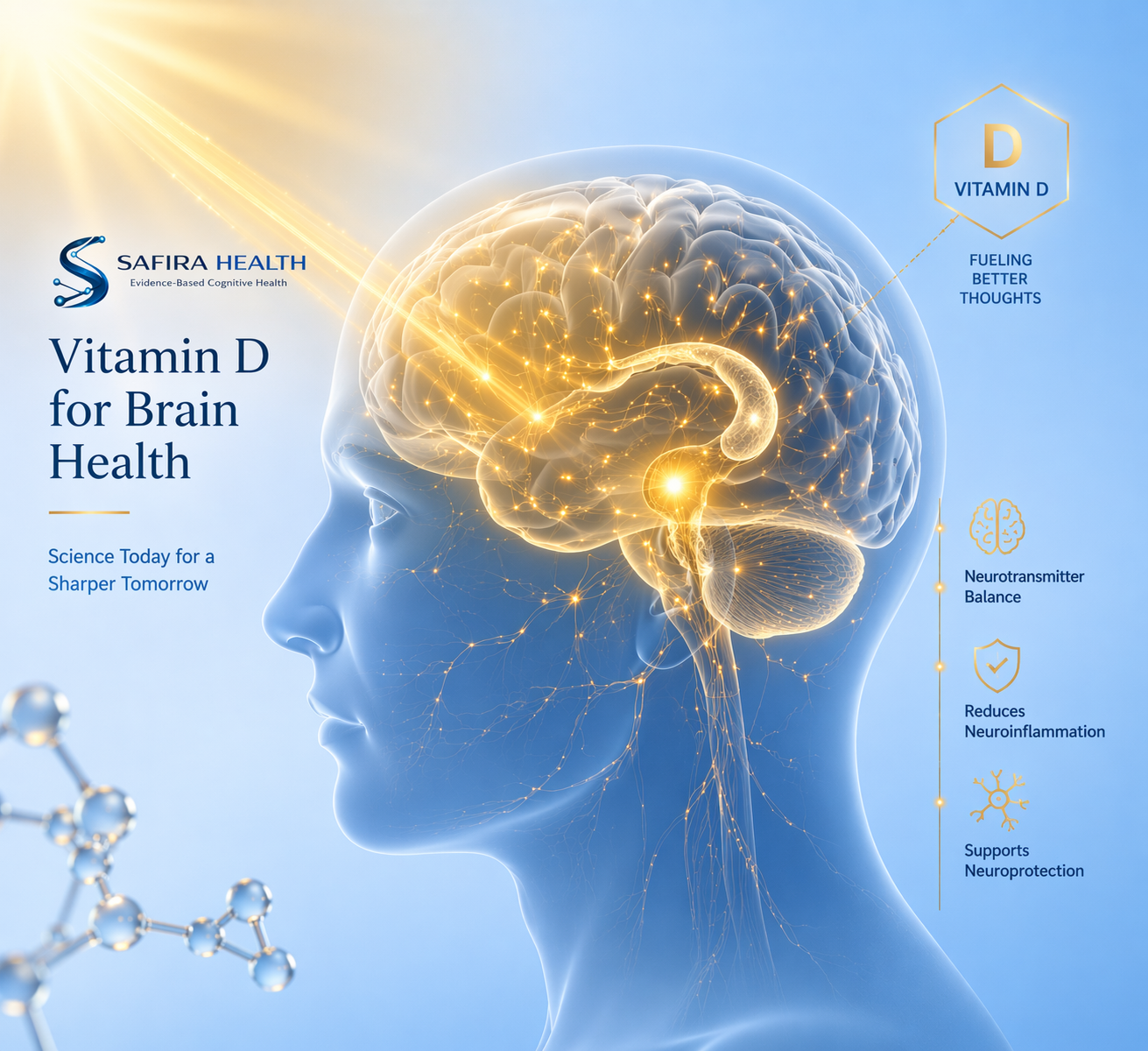
Vitamin D is traditionally associated with bone health, yet accumulating evidence indicates a broader role in neurobiology. Over the past two decades, research has increasingly explored the relationship between vitamin D status and cognitive function, including symptoms often described as “brain fog.” While deficiency is widespread globally, its neurological implications remain an area of active investigation. Current evidence suggests that low vitamin D levels may be associated with impaired cognitive performance and increased risk of neurodegenerative processes, though causality is not fully established.
What Is Vitamin D and Why Does the Brain Need It?
Vitamin D is a fat-soluble secosteroid hormone obtained through sun exposure, diet, and supplementation. In its active form (calcitriol), it functions as a transcriptional regulator, influencing gene expression across multiple systems, including the central nervous system.
Vitamin D receptors (VDR) and the enzyme responsible for its activation (1α-hydroxylase) are widely distributed in brain regions involved in cognition, such as the hippocampus, cortex, and hypothalamus. This anatomical distribution suggests a functional role in memory, executive function, and neuroendocrine regulation.
Mechanisms: How Vitamin D Influences Brain Function
Neurotransmitter Regulation
Vitamin D is involved in the synthesis of key neurotransmitters, including dopamine and serotonin. It regulates the expression of enzymes such as tyrosine hydroxylase, which is critical for dopamine production. Alterations in these pathways may contribute to cognitive symptoms such as reduced focus, mental fatigue, and impaired motivation.
Neuroinflammation and Immune Modulation
Chronic low-grade neuroinflammation is a recognized contributor to cognitive decline. Vitamin D modulates immune responses by suppressing pro-inflammatory cytokines (e.g., IL-6, TNF-α) and promoting anti-inflammatory pathways. This immunomodulatory role is particularly relevant in microglial activation states, which are central to neurodegenerative disease progression.
Neuroprotection and Oxidative Stress
Vitamin D enhances antioxidant defenses by upregulating glutathione synthesis and reducing reactive oxygen species (ROS) accumulation. Oxidative stress is strongly associated with neuronal damage and synaptic dysfunction, both of which are implicated in cognitive impairment.
Vitamin D Deficiency and Brain Fog
What Is Brain Fog?
“Brain fog” is a non-clinical term describing a cluster of cognitive symptoms, including:
- Reduced mental clarity
- Difficulty concentrating
- Slower information processing
- Memory lapses
Although not a formal diagnosis, these symptoms are frequently reported in individuals with metabolic, inflammatory, or hormonal imbalances.
Clinical and Observational Evidence
Observational studies consistently show that individuals with low serum 25(OH)D levels tend to perform worse on cognitive tests assessing attention, executive function, and processing speed. Cross-sectional analyses suggest an association between vitamin D deficiency and subjective cognitive complaints, including fatigue and impaired concentration.
However, these findings are largely correlational. Confounding factors—such as physical inactivity, comorbid conditions, and reduced sun exposure—may also contribute to both low vitamin D levels and cognitive symptoms.
Vitamin D and Cognitive Decline
Aging and Cognitive Performance
In older adults, vitamin D deficiency has been associated with an increased risk of cognitive decline and dementia. Longitudinal cohort studies suggest that individuals with lower baseline vitamin D levels may experience faster declines in global cognition over time.
Meta-analyses indicate that deficiency is associated with poorer performance in domains such as episodic memory and executive function, although effect sizes are generally modest.
Alzheimer’s Disease and Neurodegeneration
Vitamin D may influence pathways relevant to neurodegenerative diseases, including amyloid-beta clearance, calcium homeostasis, and neuroinflammation. Preclinical studies suggest that vitamin D enhances phagocytic activity of microglia, potentially supporting amyloid clearance.
In clinical populations, lower vitamin D levels have been observed in individuals with Alzheimer’s disease compared to cognitively healthy controls. Nevertheless, interventional evidence demonstrating disease-modifying effects remains limited.
Who Is at Risk of Deficiency?
Vitamin D deficiency is highly prevalent and may affect individuals across different age groups. Higher-risk populations include:
- Individuals with limited sun exposure
- People with darker skin pigmentation
- Older adults
- Individuals with obesity
- Patients with malabsorption syndromes
Lifestyle factors, including indoor work environments and low dietary intake, further contribute to suboptimal vitamin D status.
Can Supplementation Improve Cognitive Function?
Evidence from Clinical Trials
Randomized controlled trials evaluating vitamin D supplementation and cognitive outcomes have produced mixed results. Some studies report modest improvements in attention and executive function, particularly in individuals with baseline deficiency. Others show no significant cognitive benefit in healthy populations with sufficient vitamin D levels.
Overall, evidence suggests that supplementation may be more relevant in correcting deficiency rather than enhancing cognition beyond baseline.
Dosing Considerations
Optimal dosing depends on baseline serum levels, age, and individual health status. Common supplementation ranges from 800 IU to 2000 IU daily, though higher doses may be used under medical supervision in cases of deficiency.
Maintaining physiological rather than supraphysiological levels appears to be key, as excessively high vitamin D levels may carry potential risks.
Optimal Vitamin D Levels for Brain Health
Serum 25-hydroxyvitamin D [25(OH)D] is the standard biomarker used to assess vitamin D status. While thresholds vary slightly across guidelines:
- Deficiency: <20 ng/mL (50 nmol/L)
- Insufficiency: 20–30 ng/mL (50–75 nmol/L)
- Sufficiency: ≥30 ng/mL (≥75 nmol/L)
Evidence suggests that maintaining levels within the sufficient range may support overall physiological function, including aspects of brain health.
Final Verdict
Current evidence indicates that vitamin D plays a biologically plausible role in brain function through mechanisms involving neurotransmission, inflammation, and neuroprotection. Deficiency is consistently associated with poorer cognitive performance and may contribute to symptoms described as brain fog.
However, causality remains uncertain. While supplementation may improve cognitive outcomes in deficient individuals, it does not appear to act as a universal cognitive enhancer in otherwise healthy populations.
From an evidence-based perspective, maintaining adequate vitamin D levels represents a reasonable and low-risk strategy that may support overall brain health, particularly in populations at risk of deficiency.